
The construction industry has long struggled with productivity stagnation, cost overruns, schedule delays, safety risks, and fragmented coordination. While manufacturing and finance embraced data-driven automation decades ago, construction remained largely dependent on manual oversight, spreadsheets, and experience-based intuition.
Today, Artificial Intelligence (AI) is fundamentally transforming construction project management. Not as a superficial add-on, but as a predictive engine embedded into scheduling, budgeting, safety, procurement, equipment management, and decision-making.
Imagine a technical roundtable: an AI engineer explaining neural network architectures; a project director discussing schedule variance; a structural engineer evaluating load safety; a procurement head analyzing supplier volatility; and a CFO reviewing margin compression. The discussion converges on one reality — AI is not accelerating tasks marginally; it is structurally redefining how construction decisions are made.
This article examines in depth how AI systems are trained, how they generate superior outcomes, and how measurable financial gains are being achieved across real-world use cases.
From Reactive Management to Predictive Control
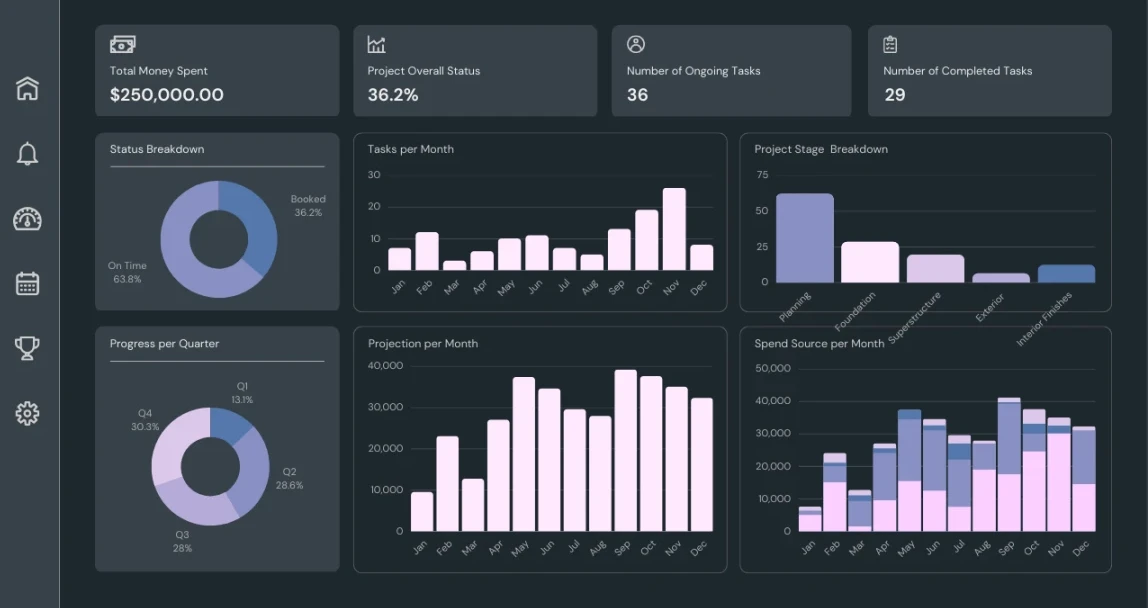 Traditional construction management is reactive. Delays are addressed after they occur. Cost overruns are discovered in monthly reviews. Safety interventions happen after incidents.AI converts this into predictive control. Machine learning models are trained using structured and unstructured datasets such as:
- Planned vs actual project schedules
- Labor productivity logs
- Equipment runtime telemetry
- Procurement lead times
- Weather patterns
- Safety incidents and near misses
- Change order histories
- Cash flow timelines
Using supervised learning, ensemble models (Random Forest, XGBoost), and deep learning architectures, AI systems identify nonlinear relationships that humans cannot detect manually.
For example, AI may learn that:
- When labor utilization exceeds 92%, accident probability rises sharply
- When supplier delivery time exceeds historical mean by 18%, cascading schedule risk increases by 2.3×
- When rework exceeds 4% during structural phase, finishing delays follow with 70% probability
This transforms uncertainty into measurable probability.
1. AI-Powered Scheduling and Critical Path Optimization
Traditional CPM assumes fixed durations. AI scheduling models treat durations as probabilistic distributions.
How It Is Trained
Training inputs include:
- Project size and complexity
- Crew composition
- Historical delay variance
- Climate data
- Supplier reliability metrics
- Permit approval durations
Output labels:
- Actual task durations
- Delay days per phase
- Critical path shifts
Neural networks and gradient boosting models generate predicted durations with confidence intervals.
Practical Example
A commercial project is planned for 16 months. Monthly overhead cost is $150,000.
AI predicts a 2.1-month likely overrun based on supplier volatility and seasonal rainfall.
Potential delay cost
$150,000 × 2.1 = $315,000
Mitigation strategies triggered by AI:
- Advance procurement of steel by 45 days
- Increase structural crew size by 10%
- Resequence finishing tasks
If delay is reduced to 0.8 months
Revised delay cost
$150,000 × 0.8 = $120,000
Avoided overhead
$315,000 − $120,000 = $195,000
This is measurable strategic value — not theoretical benefit.
2. Predictive Cost Forecasting and Margin Protection
Construction margins are often compressed by material inflation and rework.
AI uses time-series forecasting (LSTM networks) and regression models trained on:
- Historical BOQ vs actual costs
- Commodity price trends
- Fuel prices
- Currency fluctuations
- Vendor reliability scores
Steel Price Forecast Example
Project requires 400 tons of steel.
Current price is $780 per ton.
AI predicts 7% increase within 60 days.
Forecasted price
$780 × 1.07 = $834.60
Price difference per ton
$54.60
Total cost increase if delayed
400 × $54.60 = $21,840
Early procurement saves $21,840.
When similar forecasting is applied across cement, electrical, plumbing, and finishing materials, overall savings often reach 2–4% of total project cost.
For a $8 million project
3% savings
$8,000,000 × 0.03 = $240,000
This directly protects EBITDA margins.
3. AI-Based Risk Probability Modeling
Instead of qualitative risk registers, AI builds quantitative probability models.
Using logistic regression and neural networks trained on:
- Incident frequency
- Overtime hours
- Worker fatigue indicators
- Equipment density
- Temperature and humidity
Example:
Average accident cost
$40,000
AI predicts 14% accident probability during peak overtime weeks.
Expected risk cost
0.14 × $40,000 = $5,600
Mitigation reduces probability to 5%.
Revised expected cost
0.05 × $40,000 = $2,000
Risk reduction value
$5,600 − $2,000 = $3,600 per high-risk window
Over a year with 8 such risk windows
$3,600 × 8 = $28,800
AI turns safety into a financial risk optimization system.
4. Computer Vision for Real-Time Quality Assurance
Computer vision models trained on thousands of labeled site images detect:
- Improper rebar spacing
- Surface cracks
- Honeycombing
- PPE non-compliance
Example:
Required slab rebar spacing is 150 mm.
AI detects average spacing of 172 mm across 18% of slab area.
Structural analysis shows 8% load reduction.
If detected after casting, correction cost may reach $35,000.
AI inspection cost
$5,000
Avoided rework
$35,000 − $5,000 = $30,000
AI inspection systems have demonstrated up to 35% reduction in rework costs in early adopters.
5. AI in Labor Productivity Optimization
Idle labor time significantly impacts margins.
Example:
80 workers
Daily wage $30
Idle time 1.1 hours per day
Idle cost per day
80 × $30 × (1.1 ÷ 8) = $330
Monthly idle cost (26 days)
$330 × 26 = $8,580
AI crew optimization reduces idle time by 40%.
New monthly idle cost
$8,580 × 0.60 = $5,148
Monthly savings
$3,432
Annual savings
$3,432 × 12 = $41,184
6. Predictive Equipment Maintenance
Sensors monitor vibration, temperature, pressure, and load cycles.
AI anomaly detection predicts failures before breakdown.
Example:
Excavator downtime cost
$6,000 per day
Average catastrophic failure repair
$20,000
Downtime duration
4 days
Failure cost
$6,000 × 4 + $20,000 = $44,000
Preventive maintenance cost
$7,000
Avoided loss
$44,000 − $7,000 = $37,000
Predictive maintenance reduces downtime by up to 30–45%.
7. AI-Driven Procurement Optimization
AI evaluates supplier reliability based on:
- On-time delivery percentage
- Price volatility
- Quality defect rates
- Capacity utilization
If supplier A has 82% on-time delivery and supplier B has 95%, AI may calculate expected delay cost.
Assume delay cost per day is $12,000.
Supplier A average delay 5 days
Expected delay cost
5 × $12,000 = $60,000
Supplier B average delay 1 day
Expected delay cost
$12,000
Even if Supplier B charges $20,000 more upfront, AI may recommend B because total risk-adjusted cost is lower.
8. AI + BIM + Digital Twin Systems
AI integrated with BIM enables:
- Automated clash detection
- Construction sequence simulation
- Lifecycle cost modeling
- Energy efficiency prediction
Digital twins simulate 20-year maintenance cost under various materials.
Example:
Material A lifecycle cost
$1.8 million
Material B lifecycle cost
$1.5 million
Savings
$300,000 over 20 years
AI assists in long-term strategic material selection.
9. Cash Flow Forecasting with AI
AI models forecast payment inflow and outflow based on:
- Historical payment delays
- Client reliability scores
- Progress-based billing schedules
If AI predicts a 60-day payment delay on $2 million invoice, financing cost at 10% annual interest equals:
Interest per year
$2,000,000 × 0.10 = $200,000
Interest for 60 days
$200,000 × (60 ÷ 365) ≈ $32,877
Advance planning allows restructuring milestones and protecting liquidity.
Measurable Industry Outcomes
Companies implementing AI report:
- 10–20% improvement in schedule accuracy
- 5–15% reduction in project costs
- 25–40% reduction in safety incidents
- 30–50% reduction in reporting time
- 20% average productivity improvement
These are structural improvements in industry economics.
Future of AI in Construction (2025–2035)
The next decade will likely see:
- Autonomous drone-based progress verification
- Real-time schedule re-optimization daily
- AI-generated BOQs from design files
- Robotic construction guided by reinforcement learning
- Carbon optimization reducing emissions 15–25%
- AI-assisted contract clause risk modeling
- Fully integrated digital twin project ecosystems
Global construction productivity, stagnant for decades, could increase by 20–30% with mature AI adoption.
Final Insight: The Competitive Divide Is Growing
AI in construction is not about replacing managers. It is about converting intuition into scalable intelligence. It transforms fragmented data into predictive strategy. It reduces risk exposure and enhances financial stability.
Organizations that integrate AI across scheduling, cost forecasting, risk modeling, safety monitoring, procurement, and lifecycle planning are building durable competitive advantages.
The transformation has already begun. The firms that embrace AI strategically will define the new standard of construction excellence.