
Understanding the Foundation: The Technical Importance of Construction Scheduling
Construction scheduling is far more than a timeline prepared to satisfy contractual requirements. It is a structured planning system that integrates scope definition, time management, cost forecasting, and resource allocation into one coordinated execution framework. In technically managed projects, the construction schedule becomes the backbone of operational control, influencing productivity, risk management, financial performance, and client satisfaction.
In real-world construction environments, projects rarely fail due to design flaws alone. They struggle when execution sequencing is poorly defined. When excavation overlaps incorrectly with foundation preparation, when procurement timelines are underestimated, or when subcontractor mobilization is misaligned, workflow disruption becomes inevitable. Construction scheduling eliminates this uncertainty by defining task logic, dependencies, durations, milestones, and critical sequences before site work begins.
This guide explores construction scheduling from a technical and practical perspective, covering structured development methodologies, real-world examples, delay mitigation strategies, and performance evaluation techniques. It also explains how the Building Construction Work Program Schedule PDF serves as a reliable documentation and coordination tool in professional construction practice.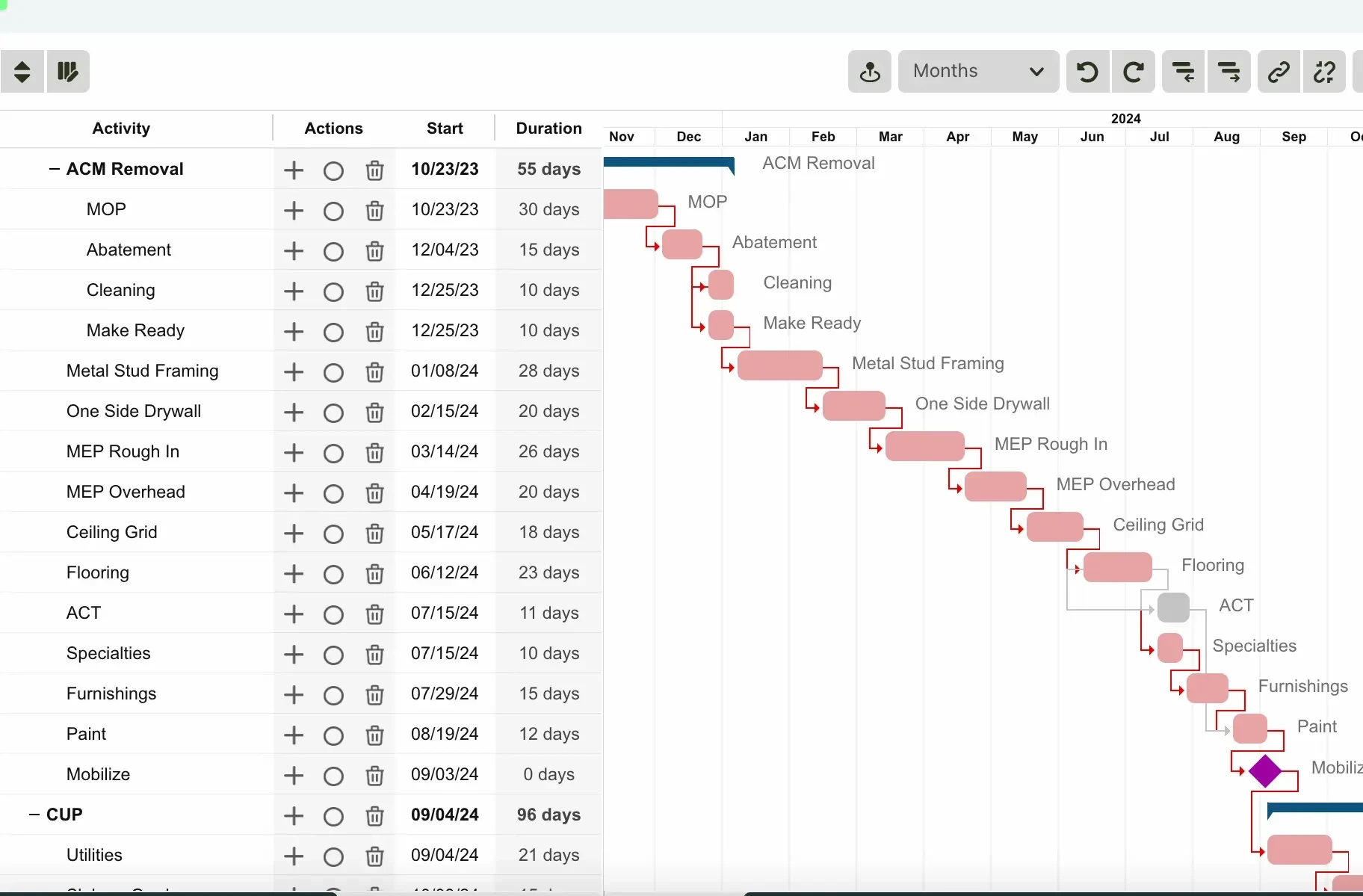
What Is Construction Scheduling? A Technical Definition
Construction scheduling is the systematic process of identifying project activities, estimating their durations, defining logical relationships between them, and organizing them into a time-based execution plan. It transforms architectural drawings, engineering specifications, and contractual obligations into a measurable timeline that governs project delivery.
Technically, a construction schedule includes activity identification, duration estimation, logical dependency mapping, resource allocation, milestone tracking, and critical path determination. These components collectively ensure that each activity occurs in the proper sequence without disrupting dependent tasks.
For example, slab casting cannot begin until reinforcement placement, inspection approval, and formwork alignment are completed. If these dependencies are not clearly defined within the schedule, site teams may proceed prematurely, leading to rework or safety risks. A structured schedule prevents such inefficiencies by establishing clear execution logic.
Why Construction Scheduling Is Critical in Project Management
Construction scheduling directly supports the three primary project constraints: time, cost, and scope. Its influence extends beyond planning into financial and operational control.
Time Control Through Critical Path Method (CPM)
The Critical Path Method identifies the sequence of activities that determines total project duration. Any delay in a critical path activity directly affects the overall completion date.
Consider a G+2 residential building project scheduled for completion in 10 months. If first-floor slab casting lies on the critical path and is delayed by five days due to reinforcement inspection issues, the entire project timeline shifts unless corrective action is implemented. Understanding the critical path allows managers to prioritize supervision and resources where they matter most.
Cost Protection Through Schedule Optimization
Time delays directly increase indirect costs. Extended site supervision, equipment rentals, temporary utilities, and security expenses accumulate rapidly when project duration extends.
For example, if monthly overhead expenses amount to NPR 150,000, a two-month delay results in an additional NPR 300,000 in non-productive cost. An effective construction schedule protects profit margins by preventing avoidable time overruns.
Resource Efficiency and Trade Coordination
Poor sequencing causes trade conflicts and productivity loss. If electrical installation and plaster work are scheduled simultaneously in the same area, workflow interference becomes unavoidable. Proper scheduling prevents resource stacking and ensures smooth task transitions between trades.
The Role of the Building Construction Work Program Schedule PDF
The Building Construction Work Program Schedule PDF functions as a formal, structured planning document. It is especially valuable for client presentations, regulatory submissions, contractor coordination, and financial institutions reviewing project feasibility.
A technically prepared work program schedule PDF includes:
- Project overview and scope summary
- Detailed activity breakdown by construction phase
- Start and finish dates for each task
- Duration calculations
- Logical dependencies
- Defined milestones
- Resource allocation notes
Because it is formally documented, it becomes a contractual and operational reference throughout project execution. In cases of delay claims or disputes, the schedule document provides clarity and accountability.
Pre-Scheduling Analysis: Laying the Technical Groundwork
Before drafting a construction schedule, analytical groundwork is essential.
Developing a Work Breakdown Structure (WBS)
A Work Breakdown Structure divides the project into hierarchical components. This structured approach ensures no activity is overlooked.
For example:
Project
→ Substructure
→ Foundation
→ Footing Reinforcement
→ Footing Casting
This layered breakdown improves planning clarity and supports accurate duration estimation.
Duration Estimation Using Productivity Data
Duration estimation must rely on measurable productivity metrics rather than assumptions.
If a bricklaying team installs 1,000 bricks per day and a wall requires 8,000 bricks, the activity duration becomes eight working days under standard productivity conditions. This data-driven approach ensures realistic scheduling.
Procurement Lead Time Integration
Certain materials require extended procurement periods. Elevators, aluminum windows, custom steel fabrication, and specialized equipment often require weeks or months of lead time.
For example, if lift procurement requires 90 days, purchase orders must be issued well before installation stages. Ignoring procurement timelines is one of the most common causes of construction schedule disruption.
Developing a Comprehensive Construction Schedule
Once groundwork analysis is complete, the drafting process begins.
The first step involves listing all project activities derived from the WBS. Next, logical sequencing is defined using relationships such as Finish-to-Start (FS), Start-to-Start (SS), or Finish-to-Finish (FF).
After sequencing, the Critical Path Method is applied to determine which activities have zero float. Float represents the amount of time an activity can be delayed without affecting overall completion. Activities with zero float form the critical path and require heightened supervision.
Resource allocation follows sequencing. If only one crane is available but two lifting operations are scheduled simultaneously, one activity must be rescheduled or additional equipment mobilized. Resource leveling ensures optimal utilization and prevents bottlenecks.
Using Scheduling Software for Technical Accuracy
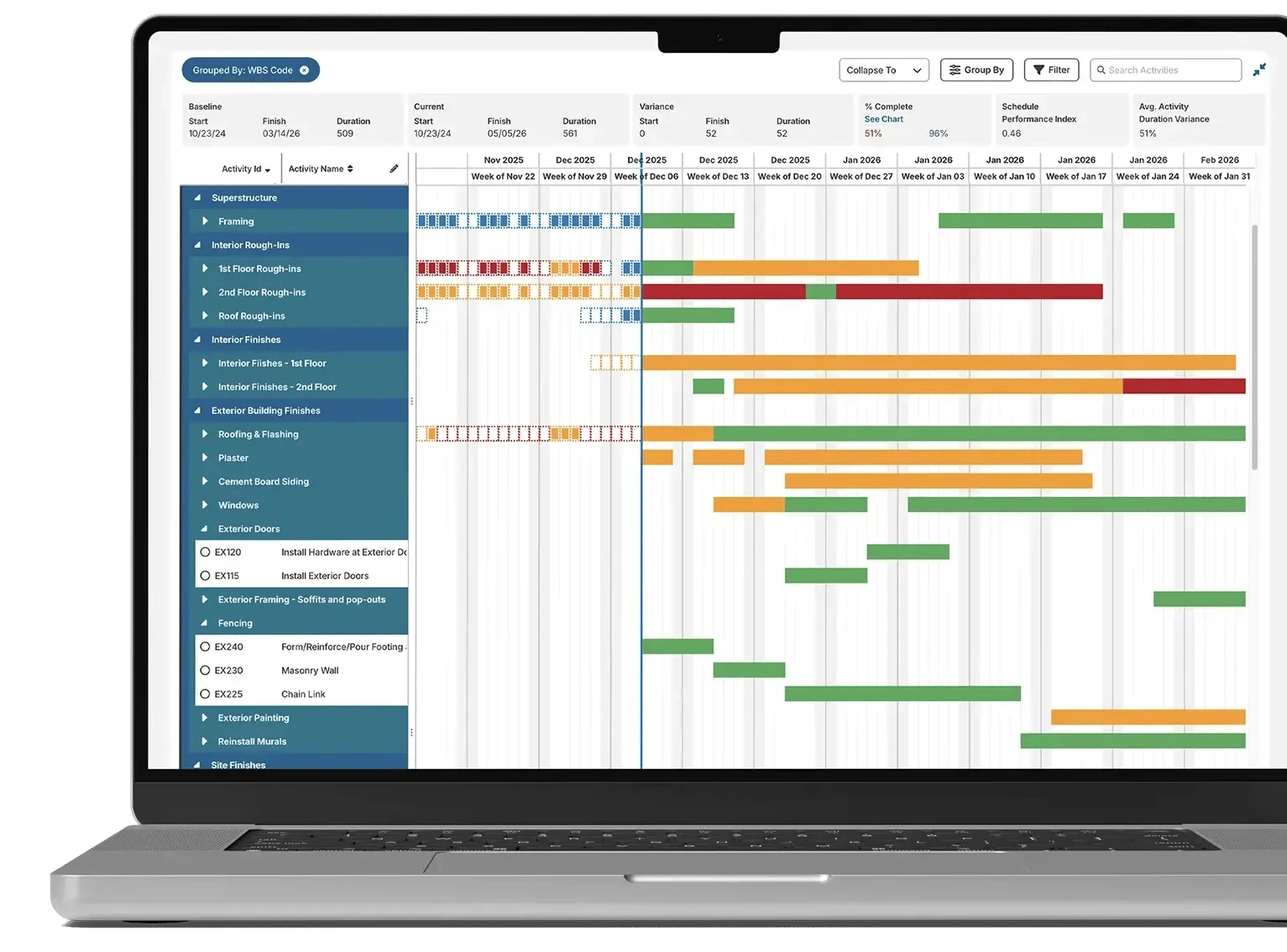
While manual scheduling is possible for smaller projects, professional scheduling software significantly improves accuracy. Tools such as Primavera P6 and Microsoft Project automate critical path calculations, resource leveling, and schedule compression analysis.
For mid-sized residential projects, structured spreadsheet templates combined with a well-prepared Building Construction Work Program Schedule PDF can deliver strong results when updated consistently.
Monitoring and Adjusting the Construction Schedule
Construction scheduling is a continuous process. Once execution begins, regular monitoring is essential.
Weekly progress tracking compares planned milestones against actual site performance. If slab casting was planned for Day 60 but completed on Day 65, a five-day variance exists. The root cause must be identified—whether labor shortage, material delay, or inspection backlog.
Corrective measures may include fast-tracking (executing parallel tasks), crashing (adding additional labor to reduce duration), or re-sequencing non-critical activities.
Advanced projects may implement Earned Value Management (EVM) for quantitative performance analysis. For example, if the Schedule Performance Index (SPI) is below 1.0, the project is behind schedule. This data-driven monitoring strengthens decision-making and reduces uncertainty.
Final Review and Performance Evaluation
As the project nears completion, a structured review evaluates schedule performance.
Key evaluation areas include:
- Accuracy of duration estimation
- Procurement timing effectiveness
- Critical path identification accuracy
- Resource utilization efficiency
Documenting lessons learned enhances future scheduling precision and organizational maturity.
Building Scalable and Adaptable Scheduling Systems
Construction firms handling multiple projects must standardize scheduling processes. Developing reusable WBS templates, maintaining historical productivity data, and integrating digital scheduling tools strengthen scalability.
Adaptability is equally important. Design changes, client modifications, and regulatory adjustments require flexible scheduling systems capable of accommodating change without destabilizing overall execution.
Conclusion
Construction scheduling is a technical discipline that integrates planning, sequencing, resource management, and performance monitoring into a structured execution strategy. It directly influences profitability, productivity, and risk mitigation.
The Building Construction Work Program Schedule PDF provides a structured documentation tool that enhances clarity, accountability, and coordination across stakeholders. When combined with critical path analysis, resource leveling, and continuous monitoring, construction scheduling becomes a powerful management mechanism that drives consistent project success.
Organizations that master construction scheduling consistently deliver projects with greater precision, reduced delays, and improved financial performance. In an increasingly competitive construction environment, structured scheduling is not optional—it is foundational.